
 Srpski
 Български
 Polski
 Hrvatski
 Čeština
 简体中文
 Deutsch
 Español
 Français
 Italiano
 Português
 Nederlands
 Svenska
 Slovenčina
 Türkçe
 Українська
How a peptide is made: solid-phase synthesis, step by step
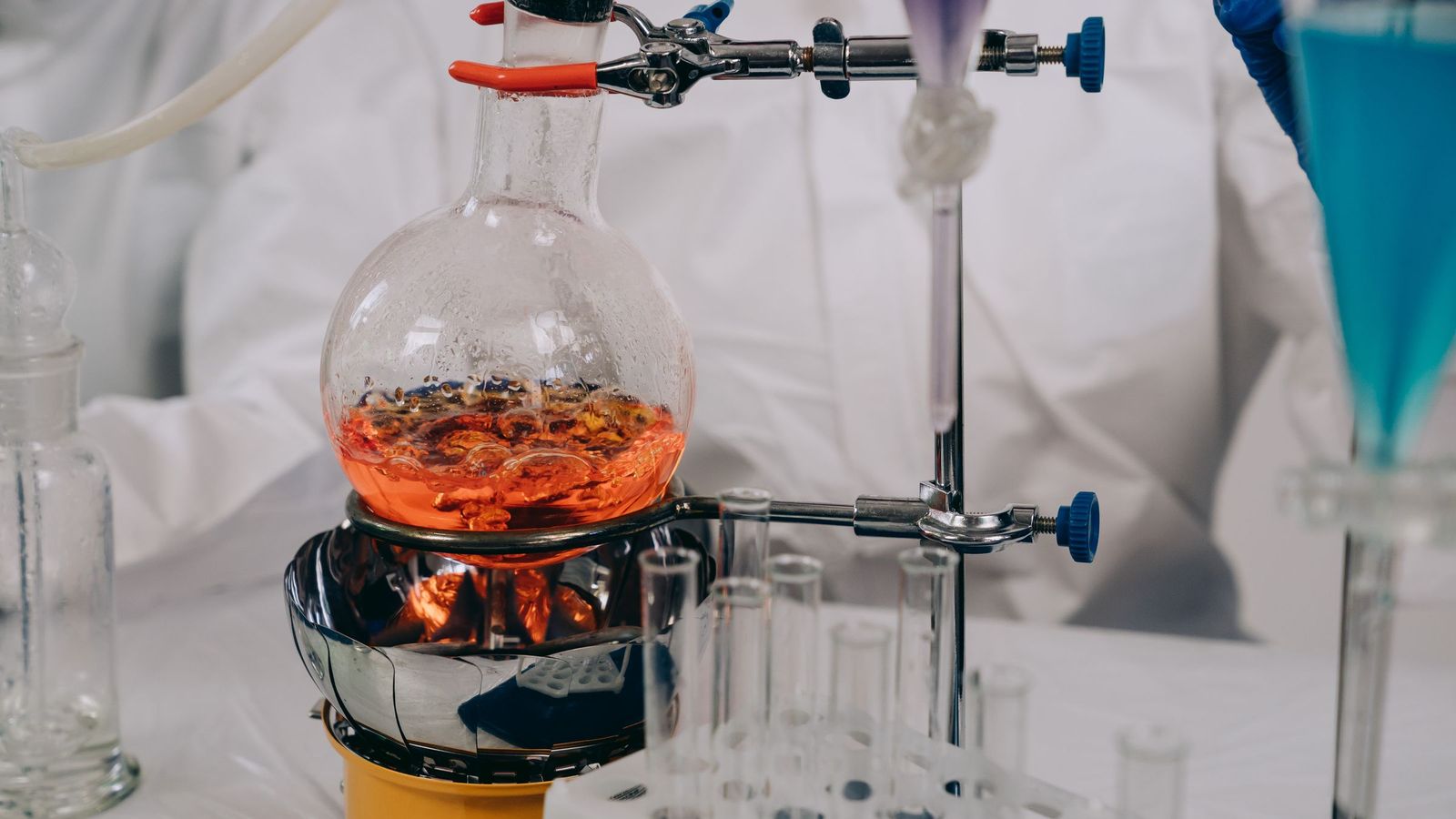
Almost all short and medium-length peptides are made today by the same method: solid-phase synthesis, known by the abbreviation SPPS (solid-phase peptide synthesis). The method was published in 1963 by the American chemist Robert Bruce Merrifield, who received the Nobel Prize in Chemistry for it in 1984.
The idea: a chain anchored to a bead
Before Merrifield, peptides were made in solution. After each amino acid was added, the product had to be isolated and purified, so synthesising a longer chain could take months.
Merrifield's idea was to attach the first amino acid to tiny, insoluble beads of polymer resin and let the chain grow on the bead. Reagents are added in excess, and whatever has not reacted is simply washed away. The product stays on the resin the whole time, so isolating it after each step is no longer necessary.
Interestingly, chemical synthesis runs in the opposite direction to nature. In the cell, the ribosome builds the chain from the N-terminus to the C-terminus, whereas SPPS starts from the C-terminus: the first amino acid on the resin is the last one in the sequence.
One synthesis cycle
The most widely used approach today is so-called Fmoc chemistry. Each new amino acid arrives with a temporary protecting group on its amino group (Fmoc), so that it does not react with itself. The side chains carry more permanent protecting groups that stay on until the end of the synthesis. One cycle looks like this:
- Deprotection: a mild base, usually piperidine, removes the Fmoc group from the end of the chain on the resin, leaving the amino group free.
- Washing: the excess reagent is washed out with a solvent.
- Coupling: the next amino acid, activated by a special reagent, is added in excess and forms a new peptide bond.
- Another wash, then the next cycle.
For a peptide of thirty amino acids, this cycle is repeated twenty-nine times. Today the work is done by automated synthesisers, in quantities ranging from a few milligrams to several kilograms.
Why every step must succeed almost perfectly
An illustrative calculation shows how unforgiving the method is. If each coupling succeeds on 99% of the chains, about 75% of the chains are full length after 29 couplings. If it succeeds on 98%, only about 56% remain full length. The rest are chains that are missing something.
This is where the typical impurities of a crude peptide come from:
- Deletion sequences: chains missing one amino acid because one coupling failed.
- Truncated chains: chains that stopped growing somewhere along the way.
- Remnants of protecting groups that were not completely removed at the end.
- Racemisation: some of the amino acids change from the natural L-form into its mirror image, the D-form.
- Side reactions of particular amino acids, aspartic acid for example.
These impurities are chemically very similar to the desired peptide. They cannot be seen with the naked eye or detected on a balance; only good analytical methods reveal them.
Cleavage, purification and drying
At the end of the synthesis, a strong acid, trifluoroacetic acid (TFA), cleaves the peptide from the resin and at the same time removes the protecting groups from the side chains. The crude peptide is precipitated and then purified by preparative HPLC: the mixture passes through a column, the chains separate, and only the fractions containing sufficiently pure product are collected. These fractions are pooled and lyophilised.
After purification in the presence of TFA, the peptide is usually in the form of a trifluoroacetate salt. This salt is often exchanged for acetate, which is why you see the word "acetate" added to peptide names. It is not a different substance, just a different partner (counterion) of the same peptide chain.
What this means for you
Synthesis explains why the quality of a peptide cannot be judged by its appearance. A chain missing one amino acid and the correct peptide look the same: like a white powder. The difference is revealed by HPLC, which measures how much of the main chain is present relative to the others, and by mass spectrometry, which confirms that the main chain has the correct mass.
View catalog