
 Srpski
 Български
 Polski
 Hrvatski
 Čeština
 简体中文
 Deutsch
 Español
 Français
 Italiano
 Português
 Nederlands
 Svenska
 Slovenčina
 Türkçe
 Українська
Heavy metals in peptides: what ICP-MS measures
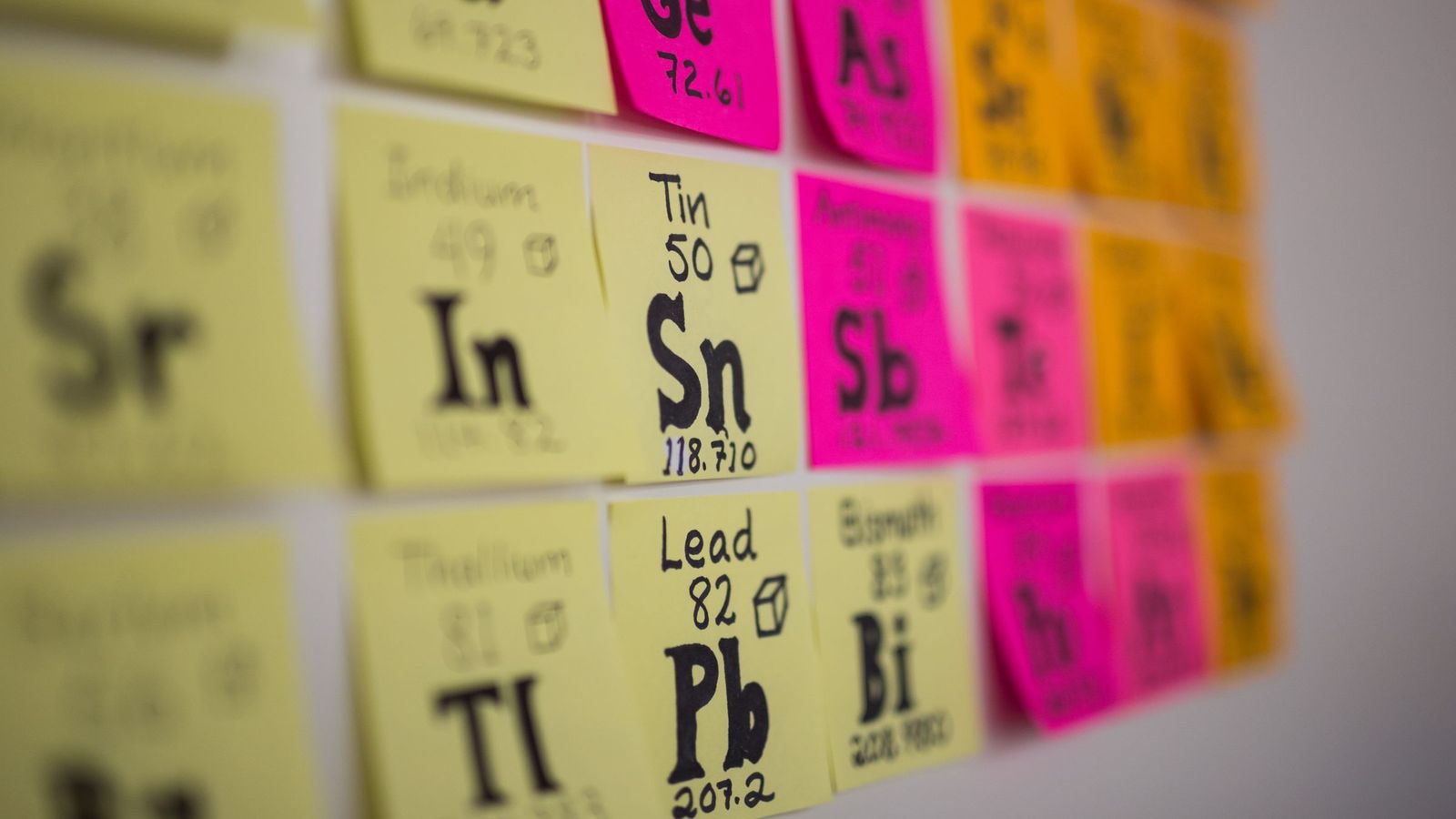
A peptide is an organic molecule, so you might think heavy metals have no business being there. Yet trace metals can find their way into almost any product: through raw materials and reagents, catalysts, water, steel equipment or packaging. That is why their content is measured rather than assumed.
Which metals are monitored
The international guideline ICH Q3D classifies elemental impurities by toxicity:
- Class 1: arsenic (As), cadmium (Cd), mercury (Hg) and lead (Pb). These elements are always assessed.
- Class 2A: cobalt, nickel and vanadium, which are encountered relatively often.
- Class 2B: rarer elements, mostly precious metals from catalysts, such as palladium and platinum. They are monitored when they are known to be used in the process.
- Class 3: elements of lower toxicity, among them copper, chromium and tin.
Results are expressed in ppm (parts per million, i.e. mg per kg) or ppb (parts per billion, i.e. µg per kg).
From precipitate to plasma
For decades a simple "heavy metals test" was used: the metals were precipitated as coloured sulfides, and the colour was compared with a standard. The test did not distinguish one metal from another and picked up some of them poorly. The United States Pharmacopeia abandoned it in 2018 and replaced it with instrumental methods.
Today two techniques based on inductively coupled plasma (ICP) are used:
- ICP-MS: the sample is digested with acid, the solution is sprayed into an argon plasma heated to several thousand degrees, the atoms are converted into ions, and a mass spectrometer separates them by mass and counts them. Sensitivity reaches parts per billion and below, for many elements in a single analysis.
- ICP-OES: the same plasma, but instead of mass it measures the light that excited atoms emit at wavelengths characteristic of each element. The method is reliable, but less sensitive.
Falsely elevated results
Both techniques have known pitfalls. In ICP-MS, an ion made up of argon and chlorine has a mass of 75, the same as arsenic, so a sample rich in chlorides can "show" arsenic that is not there. Modern instruments solve this with a collision cell or high resolution. In ICP-OES the problem is spectral overlap: an element present in the sample in large amounts emits light at many wavelengths and can raise the signal at the line of another element.
This matters especially for peptides that carry a metal by design, such as copper peptides. In these, copper is part of the molecule, not an impurity. In such a sample, a suspicious result for another element should be repeated with a different technique, usually ICP-MS, before any conclusion is drawn.
When the result is too good
A correct result for an element that was not found does not read "0" but "below the limit of quantification", for example "< 0.05 ppm". This limit depends on the element, the method and the amount of sample, so it varies from element to element and from laboratory to laboratory.
If a certificate states the same, implausibly low value for every metal, for every product and every batch, that is a reason for caution. Real measurements rarely look so uniform. We explain how to recognise a suspicious document in our article on the certificate of analysis.
View catalog