
 Srpski
 Български
 Polski
 Hrvatski
 Čeština
 简体中文
 Deutsch
 Español
 Français
 Italiano
 Português
 Nederlands
 Svenska
 Slovenčina
 Türkçe
 Українська
What peptides are and how they differ from proteins
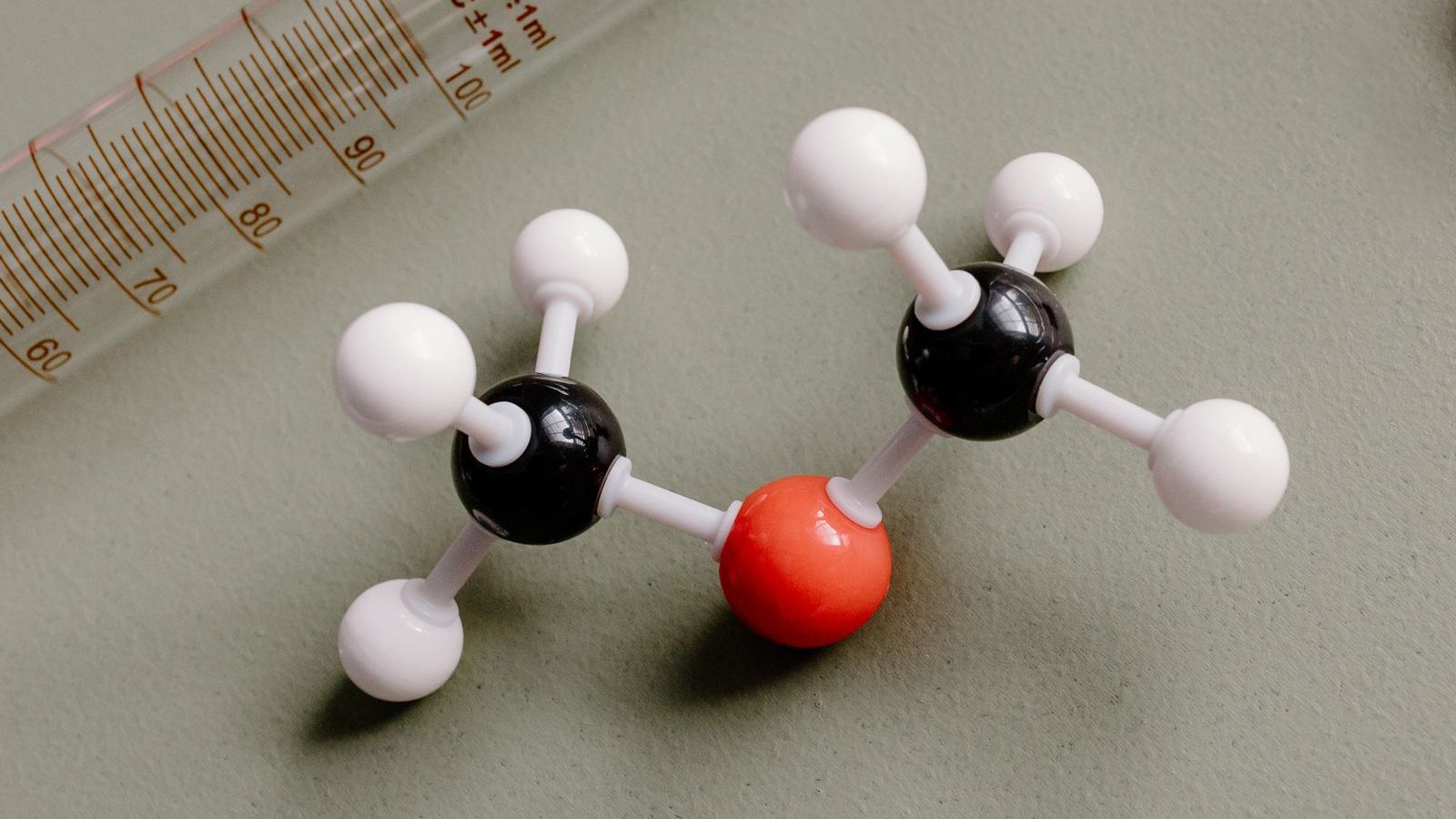
Peptides are chains of amino acids linked by peptide bonds. It sounds like a textbook definition, but almost everything that matters for peptide quality follows from it: what the molecule is made of, in what order, and how sensitive that order is to error.
Amino acids: an alphabet of twenty letters
Every amino acid has the same backbone: an amino group (-NH2), a carboxyl group (-COOH) and a side chain that sets it apart from the others. The genetic code uses twenty standard amino acids. The side chain determines an amino acid's character: some like water, some avoid it, some carry a charge, and some, such as methionine and cysteine, contain sulfur and oxidise easily.
That is why peptides are written as a string of letters. Each amino acid has a three-letter abbreviation and a one-letter code: glycine is Gly or G, histidine His or H, lysine Lys or K. The tripeptide GHK is therefore glycine, histidine and lysine, in that order.
The peptide bond
A peptide bond forms when the carboxyl group of one amino acid reacts with the amino group of the next. A molecule of water is released in the process, which is why chemists call this reaction a condensation. The resulting bond is flat and rigid, because electrons are partly shared between the carbon, oxygen and nitrogen atoms. This rigidity is the reason chains fold in predictable ways.
A chain has two different ends: the N-terminus, with a free amino group, and the C-terminus, with a free carboxyl group. A sequence is always written from the N-terminus to the C-terminus. That is why GHK and KHG are not the same molecule, even though they have exactly the same components and the same mass.
Where a peptide ends and a protein begins
There is no sharp boundary. By convention, chains of up to about fifty amino acids are called peptides, and longer ones proteins. Insulin, with 51 amino acids in two chains, sits right on that boundary.
The difference is not only one of length:
- Proteins fold into stable three-dimensional shapes, often made up of several parts, and that shape is part of their function.
- Short peptides are usually more flexible and do not have one fixed shape.
- Short and medium-length peptides are now mostly made by chemical synthesis, while large proteins are made in living cells, by so-called recombinant production.
Peptides around us
The body uses peptides as messengers: insulin, glucagon, oxytocin and vasopressin are peptide hormones, endorphins are neuropeptides, and defensins are part of the innate defence against bacteria. Peptides are also found in food and around it: the artificial sweetener aspartame is, chemically speaking, the methyl ester of a dipeptide of aspartic acid and phenylalanine.
Insulin was first used in medicine in 1922. The first peptide hormone to be synthesised chemically was oxytocin, for which Vincent du Vigneaud received the Nobel Prize in Chemistry in 1955. Today more than 80 peptide-based medicines are approved worldwide.
Why the order is everything
If just one amino acid in a chain of twenty is replaced, left out or doubled, the result is a different molecule. From the outside it looks the same, a white powder in a vial, but it is not the same peptide. That is why two things are always checked for peptides: identity, that is, whether the vial contains exactly the chain named on the label, and purity, that is, how much of other, similar chains the sample contains.
We explain how these two things are measured in our articles on HPLC purity and mass spectrometry. You can view or request the results for our batches on the Certificates page.
View catalog