
 Srpski
 Български
 Polski
 Hrvatski
 Čeština
 简体中文
 Deutsch
 Español
 Français
 Italiano
 Português
 Nederlands
 Svenska
 Slovenčina
 Türkçe
 Українська
Synthetic or recombinant: two routes to the same peptide
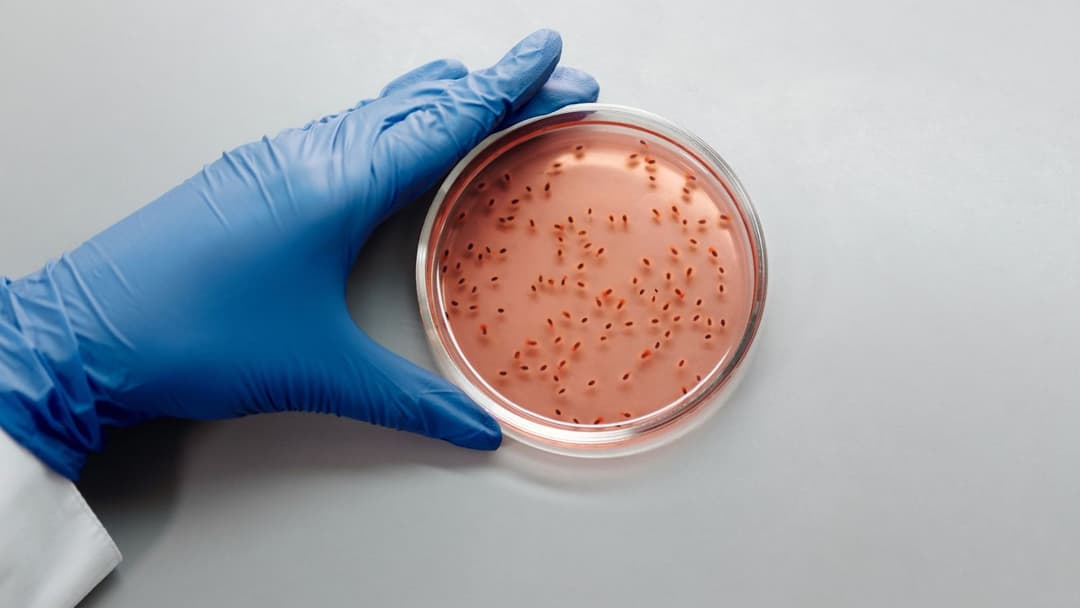
A peptide is made today in two ways. In the first, a chemist builds the chain one amino acid at a time on a solid support. In the second, that job is done by a bacterial or yeast cell, following the instructions written into a gene. The final molecule can be identical, but the routes differ in what is easy to do, what is difficult, and what ends up alongside the peptide.
Solid-phase synthesis
The chain is built from the C-terminus towards the N-terminus, while the first amino acid is attached to a bead of resin. Every cycle has the same three steps: removal of the temporary protecting group from the amino end, coupling of the next amino acid with the help of a coupling reagent, and washing away the excess. The side-chain groups stay protected right to the end, when acid cleaves the chain from the resin and frees it from the remaining protection. The cycle is described in detail in the article How a peptide is made.
This route is the natural choice for short and medium-length chains, and for everything a cell cannot make on its own: D-amino acids, non-proteinogenic building blocks, an amide at the C-terminus (NH2), an acetylated N-terminus, ring closure, attached labels. The limitation is the arithmetic of yield. No cycle runs at a yield of exactly 100 %, and small errors multiply with every added residue, so as the chain grows longer the share of incomplete molecules rises and the yield of purification falls.
Recombinant production
Here the starting point is a written record rather than a reagent. The gene corresponding to the desired sequence is inserted into a vector, the vector into a host cell, and the cells are then grown in a fermenter. Short chains are usually not expressed on their own, but fused to a partner protein that shields them from cellular proteases and makes isolation easier. After the cells are broken open, the partner is removed enzymatically or chemically, and a series of chromatographic steps follows.
The advantage is length. Long chains and proteins are obtained this way where step-by-step synthesis would be unusable, and inside the cell the chain often folds itself and closes its own disulfide bridges. The limitation is the repertoire: the cell incorporates the standard twenty amino acids, so every unusual modification calls for additional enzymatic or chemical steps.
Impurities carry the signature of the process
Since the processes differ, so does what remains alongside the peptide. With chemical synthesis, the expected findings are:
- sequences missing one amino acid or truncated at the end,
- chains with a doubly incorporated residue,
- partially removed protecting groups and adducts formed during cleavage from the resin,
- oxidised or epimerised residues,
- residual counterions and traces of solvents.
With recombinant production, the impurities originate from the host cell:
- host proteins and nucleic acids,
- remnants of the partner protein and of the enzyme used to cut it off,
- components of the nutrient medium,
- variants with a residual methionine at the N-terminus or with mispaired disulfide bonds,
- endotoxins, in Gram-negative bacteria a part of the cell wall.
This is why the control tests are chosen according to the route as well. For material of cellular origin, host proteins and host DNK are commonly measured, along with endotoxins, while with synthetic batches attention is directed to related impurities, counterions and residual solvents.
Checks that apply to both routes
Whatever the origin, the basic questions are the same. Whether the vial really holds that molecule, how pure it is and how much of it there is. Identity is confirmed by measuring the mass, purity by chromatographic separation, and quantity by a separate method, because the share of the main peak says nothing about how much peptide mass is in the powder. For each test, a good certificate of analysis (COA) states the method, the acceptance limit and the measured value, and it refers to exactly one batch.
That is why the question "synthetic or recombinant" is not a question about quality, but about what to look for on paper. Every vial carries a batch number, and every batch is tested in an independent laboratory for identity, purity and quantity. You can view or request the report for the current batch through the Certificates page.
View catalog