
 Srpski
 Български
 Polski
 Hrvatski
 Čeština
 简体中文
 Deutsch
 Español
 Français
 Italiano
 Português
 Nederlands
 Svenska
 Slovenčina
 Türkçe
 Українська
Microbiological purity: what TAMC and TYMC mean
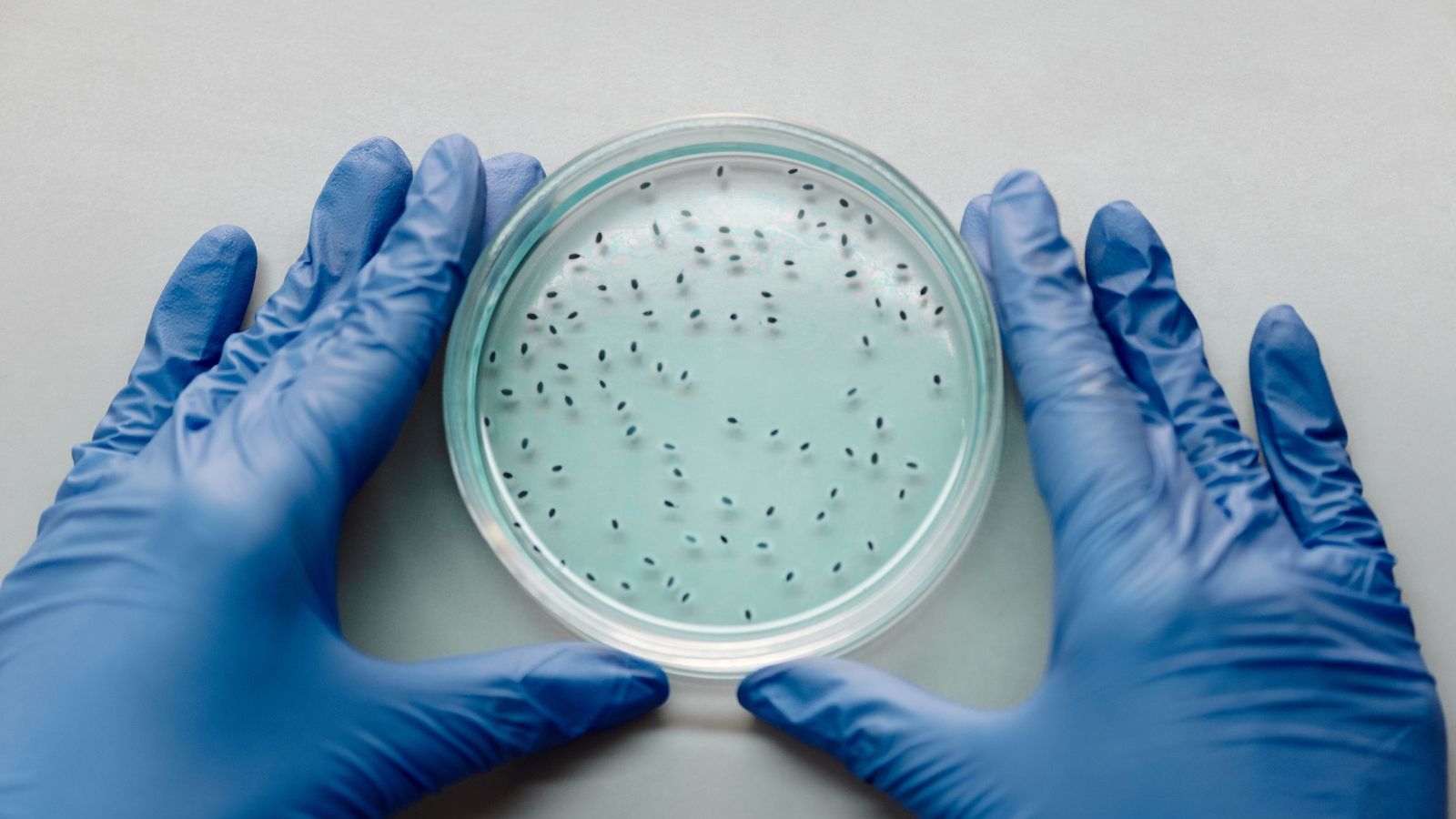
Microorganisms are everywhere: in the air, in water, on hands and on equipment. Peptide production therefore takes place under controlled conditions, and the finished product is also checked for microbiological purity. On a certificate, this usually appears as two abbreviated results: TAMC and TYMC.
Dry does not mean sterile
A lyophilised peptide contains very little water, so bacteria and moulds cannot multiply in it. But they can survive, especially as spores, and become active again when water is added to the powder. That is why the microbiological purity of a powder is not a formality.
TAMC and TYMC
The European Pharmacopoeia, in chapter 2.6.12, describes how microorganisms are counted:
- TAMC (Total Aerobic Microbial Count) is the total number of aerobic microorganisms. The sample is applied to a nutrient medium and incubated at 30 to 35 °C for three to five days, after which the colonies are counted.
- TYMC (Total Yeasts and Moulds Count) is the total number of yeasts and moulds. A different medium is used, with a lower temperature of 20 to 25 °C and a longer incubation.
The result is expressed in CFU per gram. CFU stands for colony-forming unit: every visible colony on the medium originates from a single living cell or from a small group of cells.
A result of "< 10 CFU/g" means that no colony was found in the quantity tested, in other words that the count is below the method's limit of detection. A result of several hundred or thousand CFU/g indicates serious contamination and, for most specifications, means that the batch does not pass.
Specified microorganisms
In addition to the total count, the pharmacopoeia, in chapter 2.6.13, also prescribes tests for the absence of certain species, such as Escherichia coli, Salmonella, Pseudomonas aeruginosa and Staphylococcus aureus. The result reads "absent" or "present" in a given quantity of sample.
Microbiologically pure is not the same as sterile
This distinction is worth remembering:
- Microbiological purity means that the number of microorganisms is below the prescribed limit. A few living cells may still be present.
- Sterility means that there is not a single living microorganism. The sterility test, described in chapter 2.6.1, takes 14 days and is carried out in two nutrient media, under aseptic conditions.
For peptides, sterility is not achieved by heating the finished product, because heat would damage the molecule. Instead, the peptide solution is passed through a 0.22 µm sterile filter before filling, and the vials are filled in cleanrooms of the highest grade. Only after that comes lyophilisation.
Microbes and endotoxins are not the same thing
Filtration removes bacteria, but not their endotoxins. That is why a product can pass the sterility test and still fail the endotoxin test. Good quality control tracks both results, because neither gives the full picture on its own.
How to read the report
- The method is stated next to the result, either a pharmacopoeia chapter or the laboratory's in-house procedure.
- The acceptance criterion is stated, for example no more than 100 CFU/g. Limits depend on the type of product.
- The batch number matches the vial.