

 Srpski
 Български
 Polski
 Hrvatski
 Čeština
 简体中文
 Deutsch
 Español
 Français
 Italiano
 Português
 Nederlands
 Svenska
 Slovenčina
 Türkçe
 Українська
Storing lyophilised powder: temperature, light and moisture
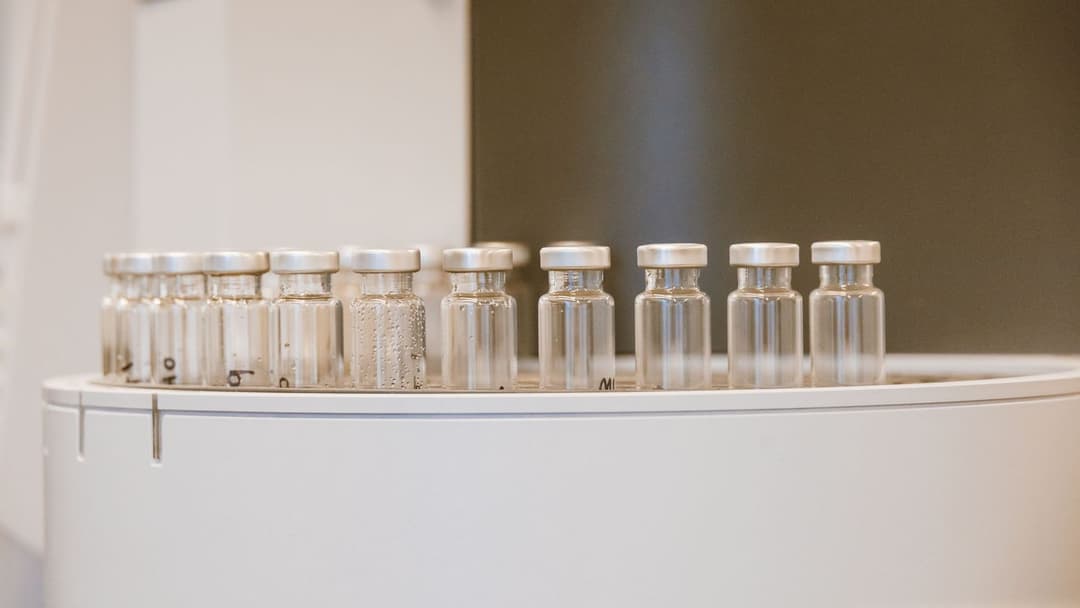
A lyophilised peptide is a dry powder. That is why it is far more stable than in solution. But a dry powder is not indestructible. It is still affected by heat, light and moisture. Laboratories keep these in check with a few simple rules that they apply consistently.
When water is removed by lyophilisation, most chemical reactions slow down because the molecules no longer have a medium in which they can easily move and meet. The reactions slow down, but they do not stop. Some amino acids are especially prone to change. Methionine and cysteine oxidise easily, and tryptophan is sensitive to light. In the presence of water, asparagine and glutamine can lose their amide group, a process called deamidation. Each such change produces a new substance, which usually shows up on the chromatogram as an additional peak. All storage rules share the same aim: to keep these slow reactions as slow as possible.
Temperature: freezer or fridge
For longer-term storage, laboratories keep lyophilised powder in a freezer at around -20 °C. At that temperature, chemical changes proceed very slowly. When the vial is going to be used soon, a fridge at 2 to 8 °C is enough.
Room temperature does not harm the powder immediately. Short periods without refrigeration are usually not a problem for a dry powder, as we explained in our article on shipping without refrigeration. When it comes to storage, however, the rule still holds: colder is better.
Light and air
The vial is kept in the dark: in a box or an opaque container. Light, especially ultraviolet light, carries energy that can trigger the oxidation of sensitive amino acids.
Air acts in a similar way, through oxygen. That is why the vial stays closed until it has to be opened and is closed again straight afterwards. If a peptide is particularly sensitive to oxidation, some laboratories fill the space above the powder with an inert gas, nitrogen or argon, before closing the vial.
Moisture
Lyophilised powder is hygroscopic, which means it absorbs moisture from the air. The absorbed water gives the molecules back some of the mobility that lyophilisation took away. This recreates the conditions for deamidation and for hydrolysis of the peptide bond. Powder that has absorbed moisture can also change visibly: it may clump, stick together or shrink in volume.
That is why vials are kept dry. Many laboratories store them in a closed container with a desiccant, such as silica gel.
A cold vial is not opened straight away
The most important rule about moisture concerns the moment of opening. If a cold vial is taken out of the freezer or fridge and opened at once, warm, humid room air reaches the cold powder. The moisture condenses on the powder, just as it does on a cold glass taken out of the fridge.
So in the laboratory, the closed vial is first left to warm up to room temperature and only then opened. While the vial is closed, moisture can condense only on the outside, where it does no harm. After opening, only as much powder as is needed is taken, and the vial is closed immediately and returned to the cold.
Avoiding frequent temperature changes
Every time a vial is taken out and put back, it goes through one cycle of warming and cooling, and each cycle carries a risk of moisture. That is why laboratories avoid frequent temperature changes:
- the vial is not taken out of the cold unless necessary,
- the powder is not kept in the fridge door, where the temperature changes every time the door is opened,
- freezers with automatic defrost periodically raise the temperature, so freezers without this function are preferred for long-term storage.
In short: a freezer at around -20 °C for longer storage, a fridge at 2 to 8 °C for shorter storage, always in the dark and dry, with the vial closed. A cold vial is opened only once it has reached room temperature.
An analysis report shows what the powder was like at the time of testing, and proper storage preserves that quality. Every Preporod batch is tested by an independent laboratory for identity, purity and quantity, and every vial carries the batch number. You can view or request the report for the current batch on the Certificates page.
View catalog